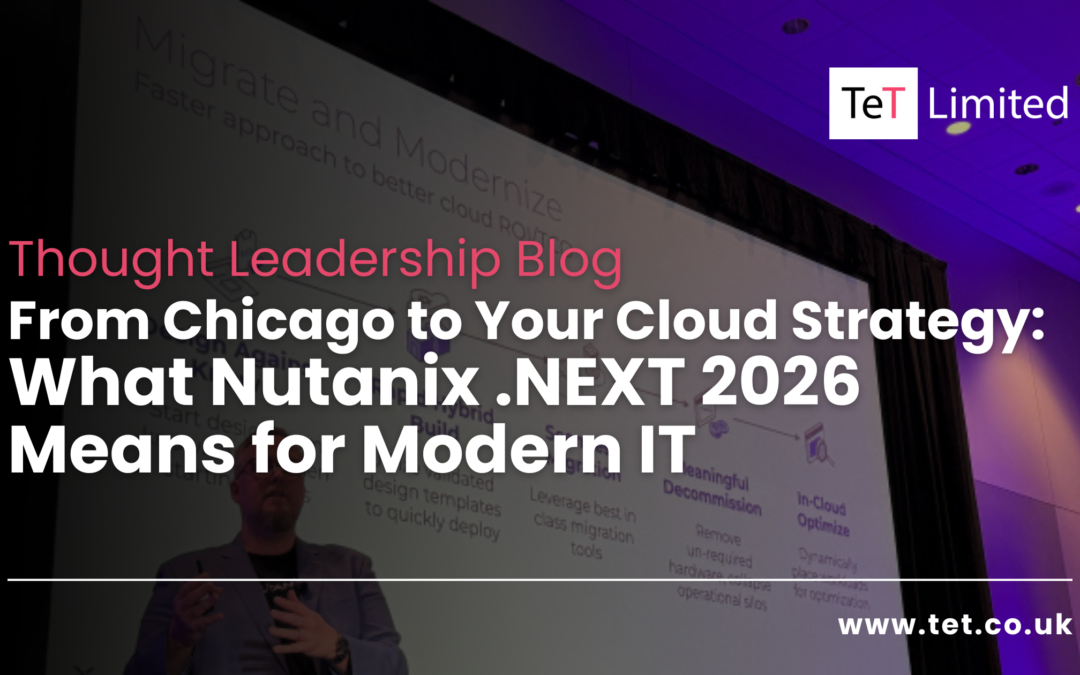
Recently, our IT Solutions Engineer Graeme Lewis, one of our cloud specialists and a recognised member of the Nutanix Multicloud Expert programme, attended Nutanix .NEXT 2026 in Chicago.
This isn’t just another tech event.
Nutanix .NEXT is where one of the industry’s leading cloud platform providers sets the direction for how organisations will build, run, and scale applications across hybrid and multi-cloud environments. It brings together engineers, customers, and partners to showcase what’s next in infrastructure, AI, and application delivery.
For us, having in-house expertise recognised at this level isn’t just something we’re proud of - it’s something that directly benefits our customers.
Because these conversations shape how technology is delivered in the real world.
First, Who Is Nutanix - and Why Does It Matter?
Nutanix is best known for simplifying how organisations run applications and infrastructure. At its core, Nutanix provides a platform that allows businesses to:
- Run workloads across on-prem, private cloud, and public cloud environments
- Manage infrastructure, storage, and compute in a consistent way
- Move applications between environments without major disruption
In a world where most organisations are juggling multiple platforms, vendors, and environments, that consistency becomes incredibly valuable.
And that’s exactly where the market is heading.
The Big Theme: AI Is Driving Infrastructure Decisions
Unsurprisingly, AI dominated the conversation. But not in the way you might expect.
This wasn’t about chatbots or surface-level use cases. It was about what AI actually requires underneath:
- GPU-accelerated infrastructure (including new support for AMD-based compute)
- High-performance storage and data platforms
- Scalable, flexible environments that can support experimentation and production
The direction is clear. AI isn’t just a workload.
It’s reshaping how infrastructure is designed.
And for most organisations, that raises an important question:
Is your current environment actually built to support what’s coming next?
Kubernetes, Containers, and Why This Matters
One of the most consistent themes across sessions was the continued rise of Kubernetes and containerisation. Now, this is where things often get overly technical - but the core idea is simple.
Traditional applications (virtual machines) are heavy, fixed, and slower to scale. Modern applications (containers) are lightweight, flexible, and designed to scale instantly.
A helpful way it was described at the event:
- Virtual machines are like owning a house for every application
- Containers are like booking a hotel room - use what you need, when you need it
Technologies like Kubernetes (via Nutanix’s platform) allow organisations to manage these environments at scale.
Why does that matter?
Because it enables:
- Faster deployment of applications
- Better use of infrastructure
- Greater resilience and scalability
In short, it’s a foundational shift in how modern IT operates.
Multi-Cloud Is No Longer Optional - But It Needs to Be Simpler
Another major focus was how organisations are running workloads across:
- AWS
- Microsoft Azure
- Google Cloud
- On-prem environments
The challenge isn’t access to these platforms. It’s managing them without creating complexity.
Sessions highlighted how Nutanix enables organisations to:
- Move workloads between environments with minimal downtime
- Standardise operations across clouds
- Modernise applications without rebuilding everything
For example, demonstrations showed workload migrations happening in seconds, not hours - a huge shift in what’s operationally possible.
Partnerships Are Shaping the Future Stack
A key takeaway from the event was how tightly integrated the ecosystem is becoming.
Announcements and roadmaps highlighted deeper alignment with:
- Cisco (compute, networking, AI-ready infrastructure)
- NetApp (enterprise storage integration)
- AMD (GPU-accelerated workloads for AI)
This matters because organisations are no longer buying standalone solutions. They’re building connected platforms and the value comes from how well those platforms work together.
What This Means for Customers
While the technology is evolving quickly, the underlying shift is clear.
Organisations are moving towards environments that are:
- More flexible (multi-cloud by design)
- More scalable (built for modern workloads and AI)
- More efficient (better use of compute and storage)
- Easier to manage (through standardised platforms)
But getting there isn’t just about adopting new technology. It’s about making the right decisions at the right time.
Why This Matters to TET (and Our Customers)
Having team members like Graeme recognised within the Nutanix Multicloud Expert programme means we’re not just consuming vendor messaging. We’re part of the conversation.
It allows us to:
Stay close to product roadmaps and upcoming capabilities, Understand how real organisations are solving challenges, Bring practical, experience-led guidance back to our customers. More importantly, it reinforces how we approach cloud and infrastructure more broadly. Not as isolated technologies, but as part of a wider environment that needs to:
- Support business growth
- Enable new workloads like AI
- Remain secure, resilient, and cost-effective
A Final Thought: The Future Isn’t One Platform
If there’s one takeaway from Chicago, it’s this: The future isn’t about choosing one cloud, one platform, or one approach.
It’s about building environments that can adapt. That can run anything, anywhere. That can scale with demand. And that don’t become more complex as they grow. That’s where the real challenge and opportunity lies.
Where to Go Next
For many organisations, the question isn’t whether multi-cloud, AI, or modern applications are relevant.
It’s: How ready is our current environment to support them?
If that’s something you’re starting to explore, it’s worth stepping back and assessing:
- How flexible your current infrastructure really is
- Where complexity is slowing you down
- What it would take to modernise without disruption
Because the organisations getting this right aren’t necessarily the most advanced. They’re the ones making clear, informed decisions early.